This will be my last entry into this blog, for now at least. It has been quite a novel experience, as I have never had my own blog before. I still consider myself the opposite of a technocrat, much preferring to read from actual books or magazines, although nowadays I do stay up to date in most archaeology news by going online.
This whole blogging assignment has made me realize that there are some interesting blogs about archaeology out there, not all neutral or academical and some even nonsensical, but interesting nonetheless; and also, that there are people out there all over the world that geek out even more when it comes to archaeology than I thought possible, and are highly committed to sharing information about the archaeology of death with the general public which is quite admirable.
Friday, March 28, 2014

Thursday, March 27, 2014
Blog Entry 9- London Rail Project Helps Solve Mystery

Today, I came across an interesting article on the BBC News Website about a site that was discovered while they were working on the London Crossrail Project. The main thing that caught my interest about it was that the finding of this site finally helped figure out the exact location of a burial site known to be located just outside of London in the 14th century ; and because the burials have been dated to the earlier 14th century (thanks to pottery found there) they are helpful in giving a glimpse into the earliest outbreaks of the Black Plage in Europe, and how people who died from it were treated before it became the full blown pandemic which we know about that decimated Europe's population.
Wednesday, March 26, 2014
Blog Entry 8- A Neolithic Style Burial

A bit off topic considering it is not about mummies or an actual archaeological finding, which is my usual focus when looking at archaeology news, but somewhat pertaining to the archaeology of death. Something I came across this week which I found interesting involved the building of replica long barrow on a UK farm located in All Cannings.
It touches upon a topic that I have mused about sometimes which is alternative forms of burial in our modern world. In this case, having your ashes enshrined in a brand new "Neolithic style" just as it was made 5,000 years ago Barrows.
One thing is having an interesting monument at the cemetery to mark your resting place but this one takes the cake. It makes me think, what does it mean to the people that will want to be placed for eternity in this place (once it is inaugurated) ?
As an archaeology nerd, I find famous monuments such as the pyramids fascinating, so maybe instead of choosing a tree urn when I pass from this mortal coil is thinking too small. I could have my ashes stored in a replica Khufu's pyramid.
Finally, what will future archaeologists make of such a thing in the future ( maybe thousands of years away)? A long barrow revival...?
Saturday, March 22, 2014
Blog Entry 7- Assesment of another blog
I chose to asses the blog entry "The Gruesome and Excruciating Practice of Mummifying Your Own Body" using my group's rubric. Since it was one of the few blogs I finally found pertaining to my case study topic, after endless "mummy blog" search queries all coming to fruitlessness or in suburban moms' ramblings.
I found the entry to have many facts about the sokushinbutsu, but to be incredibly biased. The author was also not very consistent in including their resources, direct citations are not necessary but it would be nice to know where they were getting their information from. Several ways in which the post was biased included : in the way it posted about such a sensitive topic, considering it is not just about people mummifying themselves for their own pleasure but a sensitive religious experience, not just for the sokushinbutsu but also Buddhists; one way this issue could have been avoided would have been to talk about the topic by sympathetic to the people living or dead involved in the issue.
Another way the blog entry was biased was by the descriptions of the self mummification process itself. A clear example which can be found on the title; for as factual as the blog can be, this completely ruins it due to pushing the author's opinion of the process onto the reader.This could have been remedied by addressing the topic in a neutral manner and leaving preconceptions behind
Lastly, comparing it to the rubric; another point that jumps out and which could have been useful in making a better blog, is the minimal exclusion of multimedia. The entry has only one picture, and about three other links pertaining to sokushinbutsu.
I found this blog entry to treat the subject of sokushinbutsu in a superficial and biased manner, which does not do justice to the people involved and such an interesting topic.
Another way the blog entry was biased was by the descriptions of the self mummification process itself. A clear example which can be found on the title; for as factual as the blog can be, this completely ruins it due to pushing the author's opinion of the process onto the reader.This could have been remedied by addressing the topic in a neutral manner and leaving preconceptions behind
Lastly, comparing it to the rubric; another point that jumps out and which could have been useful in making a better blog, is the minimal exclusion of multimedia. The entry has only one picture, and about three other links pertaining to sokushinbutsu.
I found this blog entry to treat the subject of sokushinbutsu in a superficial and biased manner, which does not do justice to the people involved and such an interesting topic.
Wednesday, March 12, 2014
Blog Entry 6- Thoughts on Howard Williams' Blog
 |
| Picture of a roadside memorial Howard Williams took and accompanied the post I will be critiquing |
This blog response will be based on my exploration of Howard William's blog.The blog post I chose to read, because the title captured my attention is called " Death and Deposition: Roadside Memorials and Roadpeace"; Reading the title, I thought it would have to do with how bodies of the diseased were placed in regards to travelling back in the day (the deposition part), but instead, I found out some interesting tidbits about roads in the UK and charities associated with deaths due to road collisions and how they commemorate the people affected.
At the beginning, I felt I was transported to that road side by the author in that he was very descriptive and painted a great picture, not just with words but including pictures of the actual setting. Williams introduces the sensitive topic of roadside deaths so it is more approachable, then moves on into commenting about published academic articles on the topic and also tries to make it parallel to finds in other parts of England. In summary, he makes a topic that it also pertinent to the archaeology of death, which is the commemoration of roadside deaths with memorials, also approachable to not just academics but the general public.On the other hand, meaning this in the most in a non-offensive manner, I found the blog lengthy and written in a manner more easily understood by someone from the UK, so not necessarily as accessible to all English speakers.
Wednesday, March 5, 2014
Blog Entry- 5 South American mummy in Germany
Not too long ago I came across an article about a South American mummy found in Germany.
http://www.bbc.com/news/science-environment-26357011.
I thought it was interesting that since she was taken away from her original burial context and taken to Germany during the 1800s she did not just become a victim of artifact trafficking but also a case of that mistaken identity because in her new environment it was believed she was a bog mummy.
It is great how much technology has progressed nowadays and how it can contribute to interpretations of the archaeology of death because for more than 100 years, it was unclear where the mummy was from; but now, thanks to a range of tests such as: CT scans, DNA analysis, stable isotope analysi, and even the rope in her hairdo, we can finally learn the true origins of the mummified woman and what further information her body can contribute to not just the discipline of archaeology in general but also the current understanding of parasitic infections which still continue to ravage people in South America.
Tuesday, March 4, 2014
Blog entry 4- Gay Caveman?
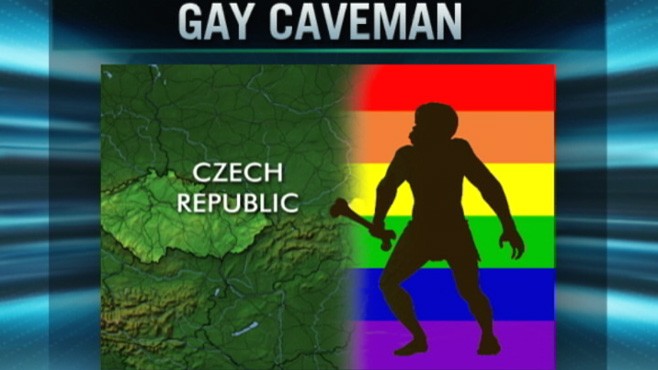
Following the blog prompts I Googled " Gay Caveman", and what ensued was a trove of sensationalist articles from the media ranging from The Telegraph to Huffingtonpost which all cited different "facts" about the Corded Ware culture, in the site were the supposedly Gay Caveman hailed from ( currently located in the Czech Republic). Quoting two different websites to point out exactly how well the media interpreted the research and blew it out of proportion:
From LiveScience: "men were traditionally buried lying on their right side with their heads pointing towards the west, and women on their left sides with their heads pointing towards the east. Both sexes would be put into a crouching position." (http://www.livescience.com/13620-gay-caveman-story-overblown.html)
From The Telegraph : "Corded Ware males were usually buried on their right sides with their heads facing east. This man, however, was buried on his left with his head facing west — a traditionally female position."
(http://www.telegraph.co.uk/news/newstopics/howaboutthat/8433527/First-homosexual-caveman-found.html)
Different sites could not even agree on the traditionally accepted positioning for a male burial in the Corded Ware culture. Nor did they consider that the male hailed from a burial dated 2800-2500 B.C. which completely rules him out as being a "caveman". Misunderstandings of gender and sexual orientation aside, the Gay Caveman was not even a caveman.
The Telegraph at least quoted the original statement from the archaeologist that sparked the media furore : " "We believe this is one of the earliest cases of what could be described as a 'transsexual' or 'third gender grave' in the Czech Republic," archaeologist Katerina Semradova told a press conference on Tuesday."
It serves to take note, that nowhere in this statement is the purported Gay Caveman's sexual orientation mentioned, therefore after all the explosion of articles with a little careful reading without even going into researching academic papers on the subject, one finds out the "Gay Caveman" is neither gay nor a caveman.
We might never fully find out how that person was perceived in their community back in those days, but the least we can do is consider when coming accross mass media articles like this to read everything with a grain of salt, always look under the surface and have a little more interest in the true archaeology of death.
Subscribe to:
Posts (Atom)